
Checking for a Montgomery County Warrant
Georgia offers no statewide public warrant database. State guidance points people to the sheriff of the county where the warrant was likely issued, so in Montgomery County the first call belongs to the Sheriff's Office, followed by the court that may have entered the order. When you phone, have a full legal name and date of birth ready for a private conversation. Those details help staff tell apart people who share a name. Keep them out of public messages. The county itself posts no public name-search field and runs no dedicated warrant line, so work the offices in that order.
- Call the Sheriff’s Office and ask which desk can confirm a county warrant.
- Contact the court named on a citation, notice, or case paper.
- Ask the Superior Court clerk about the case file when a felony case may be involved.
- For a city or traffic matter, contact the municipal or Probate Court clerk.
- If status is confirmed, speak with a Georgia lawyer before appearing in person.
No Montgomery County Warrant Portal
Montgomery County publishes no public warrant search form or countywide active-warrant list. That gap matters. A blank result on a court calendar, jail report, payment page, or records service proves nothing about whether a warrant exists. The state's existing-warrant instructions send people to the county sheriff, and a sheriff typically confirms only warrants tied to that county.
A Montgomery County warrant check starts with direct contact, not a public name box. Ask what staff can confirm and which ID details are needed.
Two state systems do not fill the gap. The Georgia Crime Information Center supports law-enforcement wanted-person records but stays closed to public search. PeachCourt offers account-based access to some Superior Court documents, not a full Montgomery County warrant index.
Montgomery County Warrant Types
Warrant records in Montgomery County arise at different stages of a case, and the issuing office decides where the best record sits. A judge may issue an arrest warrant on sworn facts showing probable cause. A bench warrant or order for arrest can follow when someone fails to appear. A search warrant authorizes a defined search and may stay restricted while the inquiry remains open.
| Type | How it arises | Likely source |
|---|---|---|
| Arrest warrant | Sworn facts show probable cause | Magistrate or Superior Court, then sheriff |
| Bench warrant | A required court response is missed | The court that set the date |
| Traffic warrant | A traffic case or date remains unresolved | Probate or municipal court |
| Search warrant | A judge permits a specific search | Court record, with access limits |
Georgia materials also use "capias," "FTA," and "order for arrest." Montgomery County pages describe no separate local capias-for-fine process, so bench warrant is the clearest public term for a missed court date.
Montgomery County Offices Split the Record
Montgomery County's justice system splits its work by function. The Superior Court of the Oconee Judicial Circuit handles felonies and other cases within Georgia's general trial jurisdiction. Tammy Foskey, Clerk of Superior Court, keeps the court case records and handles related record and fine duties. Magistrate Court executes arrest and search warrants for law enforcement, holds first appearances, considers bond, and hears civilian warrant applications.
| Office | Best question | Boundary |
|---|---|---|
| Sheriff | Is a county warrant held for service? | Not a statewide check |
| Superior Court clerk | What does the felony case file show? | Some material may be sealed |
| Magistrate Court | Was a warrant or first appearance handled? | Not every city case |
| Probate or city court | What is this citation’s status? | Use the court named on the paper |
The county court directory is the safest start when the court is unknown.
Inside a Montgomery County Warrant Record
A warrant record in Montgomery County may list the subject, the alleged offense, the issuing court, and the issue date. It may also carry a warrant or case number and a status term. The county publishes no local warrant-number pattern, so assume no numeric format. A court case number and a warrant number can differ.
| Identifier | A warrant or case number assigned by the office; no countywide format is verified. |
|---|---|
| Name | The legal name attached to the order; date of birth may help confirm identity. |
| Charge or reason | The alleged offense or missed duty that led to court action. |
| Issuing court | The court with power to change, recall, or quash the order. |
| Bond | A bond term if set; no general Montgomery County sum is published. |
| Status | Issued, active, served, returned, recalled, quashed, or unknown. |
A payment receipt, calendar entry, or old case image does not show that a Montgomery County warrant was cleared. Confirm status with the court.
Montgomery County Sheriff Phone Conflict
Official listings give two numbers for the Montgomery County sheriff and jail. The county Sheriff page posts 912-583-2321 at 208 East Broad Street in Mount Vernon. County jail reports and the Georgia Sheriffs' Association list 912-583-2521 with the jail or sheriff mailing contact. Neither source labels its number a dedicated warrant line. The sheriff's page also lays out the office divisions and its public contact block.
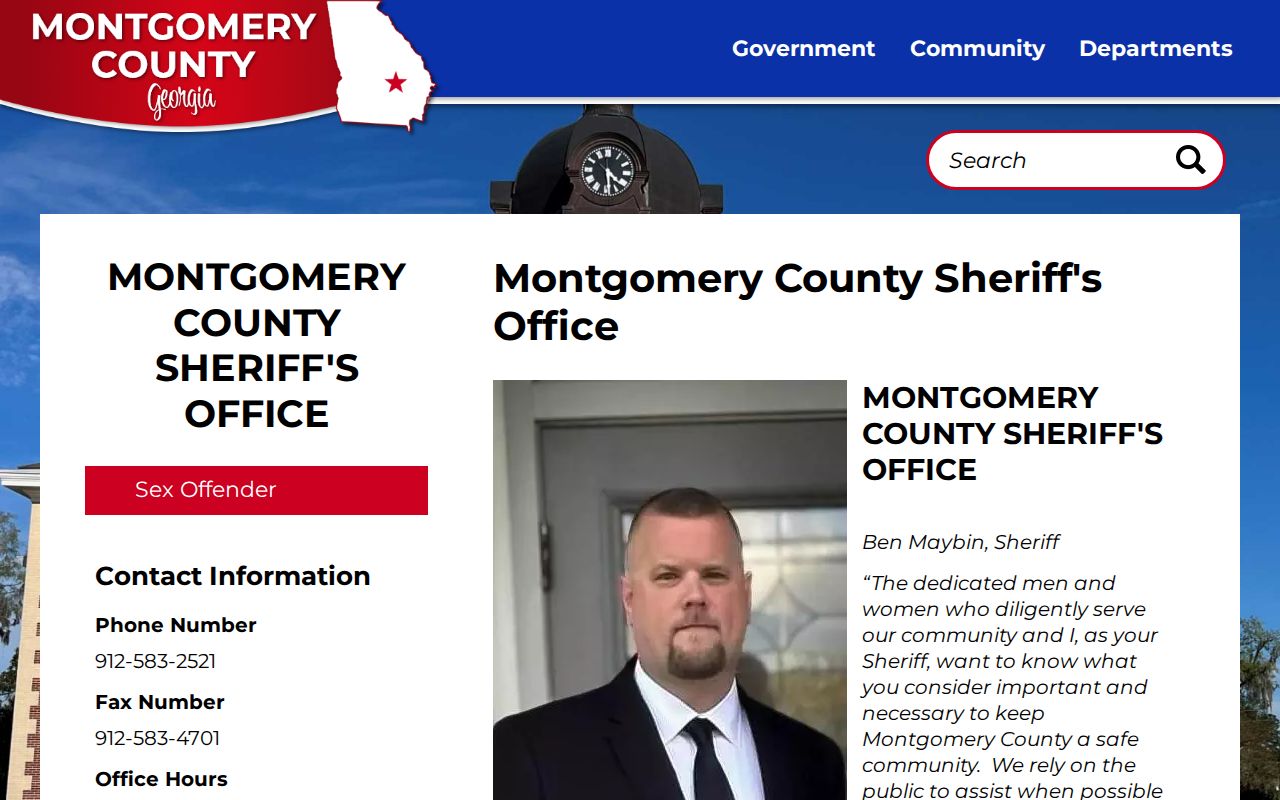
Call before you drive to an office. State guidance warns that asking in person can end in custody if an active warrant is confirmed. Ask which desk handles warrant status and whether staff will confirm facts by phone. The office contact page offers a route in, but it exposes no public warrant name search. A jail report is not a warrant roster either. It is an operational contact point, not a count or list of active Montgomery County warrants.
Issuing Warrants in Montgomery County
Courts issue warrants; law-enforcement agencies serve them. In official material, Montgomery County Magistrate Court has the clearest local warrant role. It executes arrest and search warrants, keeps judicial availability for warrant execution, conducts first appearances and preliminary hearings, and hears civilian warrant applications. Judicial availability does not mean a public record counter stays open around the clock. The sheriff's public page lists patrol, investigations, detention, communications, and courthouse security, with no separate warrant unit. Superior Court handles felony matters across the six-county Oconee Judicial Circuit, while Municipal and Probate courts take the narrower city and traffic cases.
Montgomery County Sheriff’s Office
208 East Broad Street
Mount Vernon, GA 30445
912-583-2321
Montgomery County Magistrate Warrant Work
The Montgomery County government home page sets the county-seat scene and routes readers into local court and sheriff departments.

The county's online interface is a department directory, not a Montgomery County warrant roster. No warrant list sits there. The Magistrate Court page connects steps people often mistake for separate systems, since one case can run from application to hearing. A warrant begins with an application and sworn facts. An officer then executes it. The case may next reach a first appearance, a bond issue, or a preliminary hearing, while the sheriff stays the better source for current service status.
- Probable cause
- Facts sufficient for a judge to permit an arrest or search.
- First appearance
- An early hearing where charges, rights, and release may be addressed.
- Preliminary hearing
- A hearing that tests whether a case may proceed at that stage.
- Recall or quash
- A court act withdrawing or canceling a warrant.
A civilian warrant application in Montgomery County is a court process with notice and hearing rules, not a public lookup tool.
If You Have a Warrant in Montgomery County
An urgent warrant question deserves more than an old docket image or a third-party result. Confirm the details with the court or sheriff. Get the court, case number, warrant status, and bond terms. A Georgia lawyer can help. Counsel may reach the proper office, weigh a voluntary appearance, and ask about a recall, reset, or bond; Montgomery County posts no general bond sum or walk-through program.
Calling is safer than arriving without a plan. Georgia guidance notes that an in-person warrant inquiry may result in custody.
Missed a date? Contact the clerk of the court that set it. Felony cases need the Superior Court clerk and counsel. A traffic citation starts with Probate Court or the city court named on the ticket. Payment alone may not update each system at once. Ask the issuing court in Montgomery County to confirm the recall.
Montgomery County Traffic Warrant Route
Montgomery County Probate Court handles misdemeanor traffic citations. Traffic court generally falls on the second Wednesday of each month at 10:00 a.m., and the court asks everyone to arrive before 9:45 a.m. Confirm the schedule before travel. The payment route asks for a citation number, date of birth, and jurisdiction. Those fields find a citation. The tool is not a warrant search. A missed traffic date can also start a Georgia Department of Driver Services failure-to-appear process. DDS ties a 28-calendar-day period to notice, then court release and state processing after the case is resolved. A DDS hold is administrative, not a court warrant. The DDS FTA page explains the sequence, but confirm both the Montgomery County court status and any separate DDS task.
Montgomery County Warrant Records Access
The Georgia Open Records Act, O.C.G.A. §§ 50-18-70 et seq., opens existing public agency records to requesters, subject to exemptions. Name a record the office keeps. A request can seek an existing warrant log, a dated count, a policy, or a specified case record. The agency need not create a new countywide report. Court files add their own rules. Sealed, juvenile, protected, and investigative material stays restricted. The Attorney General's FAQ covers timing, costs, exemptions, and the existing-record limit for Montgomery County requesters.
- Custodian
- The office that keeps and responds for a record.
- Redaction
- Removal of protected details from a releasable record.
- Sealed record
- A record withheld by law or court order.
Montgomery County Superior Court E-Access
Georgia Courts lists PeachCourt as the electronic access provider for Montgomery County Superior Court. PeachCourt needs an account for document search. It is no public Montgomery County warrant index. Nor does it replace the clerk or sheriff. The official Oconee Judicial Circuit page places Montgomery County Superior Court within its six-county circuit.
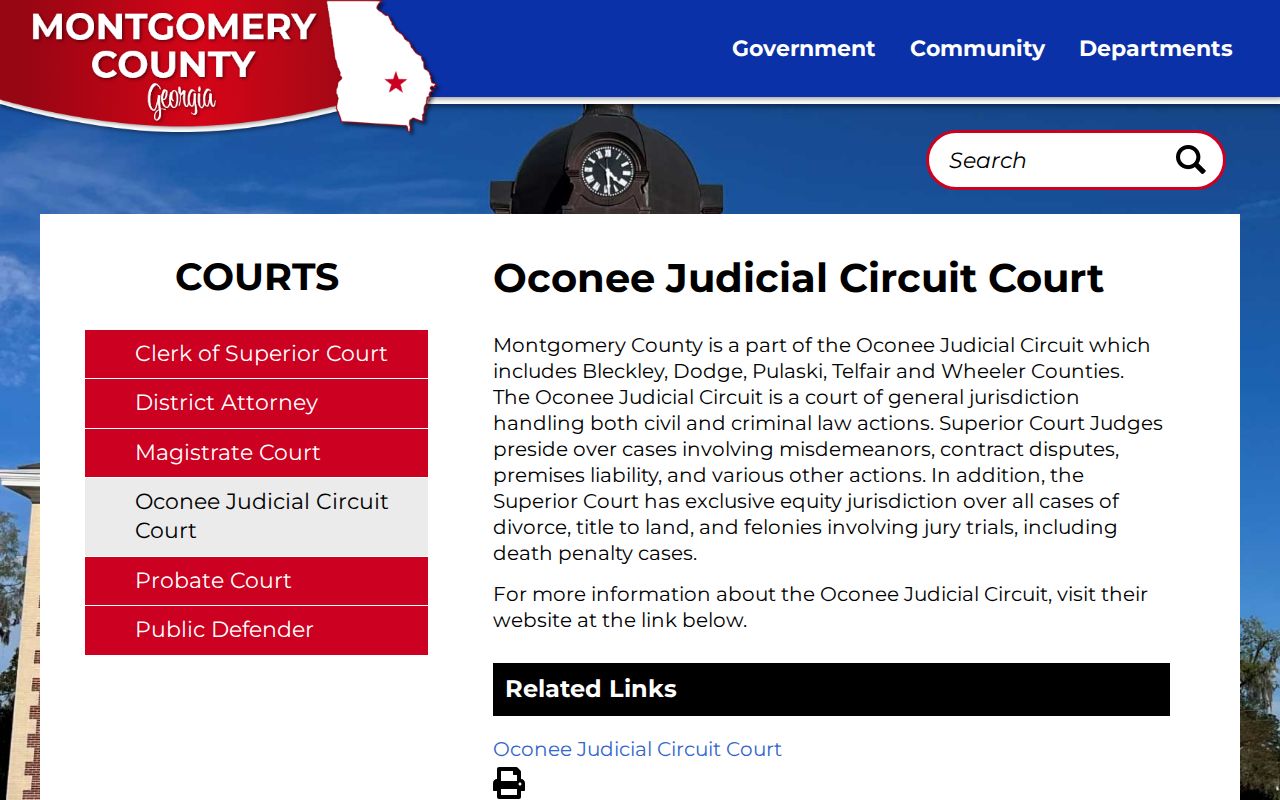
The circuit page maps shared judicial offices and calendars. The Montgomery clerk stays the local case-record contact. Document access and live warrant status are separate questions. The clerk answers for the court file, while the sheriff is the practical Montgomery County contact for service status.
Montgomery County and Federal Warrants
County and federal warrant routes do not mix. Montgomery County sits in the Dublin Division of the Southern District of Georgia. Federal dockets run through PACER, and federal enforcement can bring in the U.S. Marshals Service. Neither route replaces the sheriff for a county warrant.
| Question | Local route | Federal route |
|---|---|---|
| Who issued it? | Montgomery court | United States court |
| Where is the file? | Issuing clerk | District clerk or PACER |
| Who may serve it? | Sheriff or police | U.S. Marshals or federal agency |
The Dublin Division page gives the federal court route for Montgomery County. Use it only for a federal matter.
Montgomery County Most Wanted Limits
Montgomery County publishes no official most-wanted roster, active-warrant list, roundup, reward plan, or update schedule. A jail report is not one. Nor is another Georgia county's program. Treat any later roster with care. Even an official list would be a selected public-safety roster, not proof it includes every active warrant. The Georgia courts and corrections route sends warrant questions toward county sheriffs and court questions toward the proper court.
The state routing screen backs up the local fallback chain. It offers no wanted-person roster. Never copy an official wanted list onto a private page with names, photos, or case details. Tips belong with a verified law-enforcement channel. Do not approach anyone yourself. Call 911 for an emergency, and remember that a missing published list does not mean the Montgomery County sheriff or courts hold no warrant records.
Montgomery County Warrants by City
Montgomery County's city pages run in 2020 Census order: Mount Vernon, Ailey, Uvalda, Higgston, and Alston. Population sets the order, not warrant volume. No city caseload count is published. Let the citation or notice name the court that controls the next step.
Mount Vernon
County seat with a documented municipal court calendar and payment-only links.
Ailey
Use the city contact to identify the right clerk.
Uvalda
Confirm the court named on the paper.
Higgston
Limited civic hours make a call-first check useful.
Alston
The city profile is a civic contact, not a warrant database.
Vidalia crosses the line into Montgomery County but sits mainly in Toombs County, so it does not push out a fully local municipality here. The order stays local.